
India’s grocery & food sales were responsible for 56.6% of total retail consumption in FY2025. But as simple as the supermarket business looks, there is a very complex system behind it. From shelves, aisles, and cashiers, there are multiple parts of supermarket stores that work continuously for customers.
A successful supermarket business uses the following:
- Suppliers
- Warehouses
- Distribution Centres
- Inventory
- Employees
- Technology
- Customers.
This is the right blog for understanding how supermarkets work and how you can also make your supermarket a successful venture.
What Is a Supermarket Business?
A supermarket is a big retail store that sells almost every home essential product. Most supermarkets sell products such as:
- Packaged food
- Beverages
- Household essentials
- Personal-care products
- Fresh produce
- Dairy
- Frozen food etc.
The basic supermarket business model includes suppliers and customers. But here, customers themselves choose to explore the store and buy what they want.
But supermarket operations are more demanding for it needs multiple areas for different kinds of products. For example, shelves, cold storage, and discount areas.
Good supermarket management helps deal with wastage, overstocking, and shelf management.
How Supermarkets Work: The Complete Business Workflow
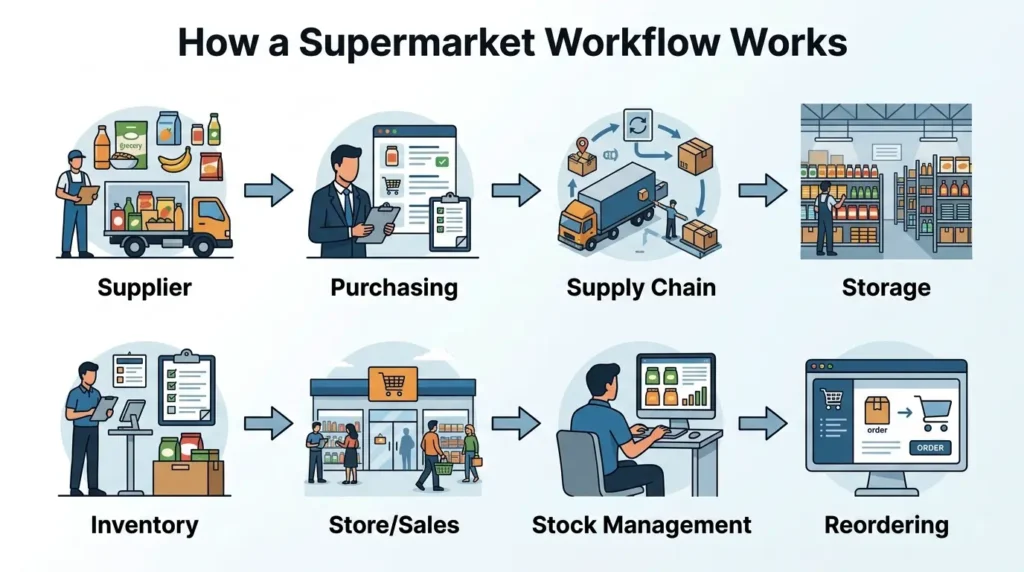
Every supermarket process follows a cyclic path.
Here it is:
- Supplier
- Procurement
- Distribution Centre
- Warehouse & Cold Storage
- Store Inventory
- Shelf Stocking
- Customer Shopping
- Checkout & Billing
- Sales Reports
- Inventory Updates
- Reordering
Note: Every step builds a healthy supermarket workflow.
Stage 1: Product Sourcing and Procurement
The first things you need to run a supermarket are good and reliable manufacturers, distributors, farmers, wholesalers, and other suppliers. They are your supermarket’s backbone.
Your purchasing team checks for the right price, quality, delivery reliability, payment terms, and product demand. They check data, season, and demand to select the right products.
For example:
- Cold drinks for summer
- Sweets & snacks for festivals.
The supermarket supply chain moves products from warehouses or distribution centres to customers. Most importantly, grocery store operations follow a centralised system across multiple stores.
Stage 2: Managing Inventory Before Putting the Products On The Shelves
When new products arrive, the staff first check for:
- Quantities
- Packaging
- Product condition
- Batch numbers
- Expiry dates
This ensures quality checks. Next, the staff arrange all the products in their respective shelves and cold storages to reduce spoilage and protect product quality.
Inventory management tracks every sale, availability, demand, and wastage.
Supermarkets always aim for a balance. No overstocking and no minimal wastage. According to research, supermarkets often follow a FIFO practice, selling older stock first.
Stage 3: They Create a Better Shopping Experience
Supermarkets are not just for buying. People actually move there, exploring all the shelves and products.
It’s a staff member’s responsibility to check the product and organise those on the shelves. This is shelf stocking.
But supermarkets just put anything anywhere. They plan the layout to influence the buying decisions of the customers.
Fresh Grocery Products | Entrance |
Essentials | Deeper Inside |
Top Level Shelves | Premium Products |
Eye-level Shelves | High Margin Products |
Middle Level Shelves | Regular Brands |
Low-Level Shelves | Family and Value Packs |
End Caps | Promotional Products |
Checkout | Small Inexpensive Products |
Note: Always keep complementary products together, such as Tea → Biscuits → Rusks
The goal is to create a seamless experience for all the customers through all different departments.
Stage 4: The Checkout and Billing Process
At the checkout, supermarket cashiers scan product barcodes, and the cash register system scans every detail about the product.
Modern POS systems allow customers to pay with cash, cards, UPI, mobile wallets, or other digital methods. Digital payment has become essential, as there were more than 20 billion UPI transactions in February 2026 alone.
The supermarket inventory system must count every sale. They should even track the following:
- Best-Selling Products
- Busiest Hours
- Promotional Effects on sales.
Stage 5: What Happens After Every Customer Purchase?
Every sale starts a new cycle of retail store operations. Here are five things every supermarket does after sales:
Inventory Updates: The POS system records the sale and updates available stock.
Automatic Stock Reordering: The inventory alerts the team about stock needs or replacements.
Sales Reporting: Managers can review their stocks and sales daily, weekly, or monthly. This helps them compare trends and sales.
Demand Forecasting: The system creates a detailed report about sales and forecasts the future demands.
Supplier Replenishment Cycle: The purchasing team then places the needed orders with suppliers, restarting the complete cycle.
The complete supermarket operations are a continuous cyclic system that balances stability and momentum.
How Every Department Works Together in a Supermarket?
A supermarket has multiple supermarket management teams that work together to create a smooth flow & customer service. Here are some of them:
- Purchasing Team – They select suppliers, negotiate prices, and order products.
- Inventory Team – They manage stocks, receiving, storage, and expiry dates.
- Merchandising Team – They decide how to show products on shelves and promotional areas.
- Cashiers and Checkout Staff – They handle transactions and the checkout process for customers.
- Store Managers – Store managers coordinate every team and everyday operations.
Technology Behind Modern Supermarket Operations:
Here are some of the best technologies that support every supermarket process.
- POS Systems – process transactions and capture sales information
- Barcode Scanners – make checkout faster and automated.
- Inventory Tracking Software – Tracks stocks and alerts in time.
- Sales Analytics – Helps understand customer demand.
- Automated Stock Replenishment – Uses sales data to show forecasts and trends.
Common Challenges in Running a Supermarket Business:
Here are the top challenges every owner faces running a supermarket business:
- Managing thousands of SKUs effectively every day.
- Reducing food waste.
- Maintaining the products when customers visit.
- Maintaining competitive prices, quick checkout, clean stores, convenient layouts, and multiple payment options.
- Controlling operational costs such as rent, electricity, refrigeration, salaries, logistics, technology, packaging, maintenance, and wastage.
Next, you also need to care about competition. Notably, the Indian supermarket sector recorded 8% sales growth in 2025.
Best Practices for Running a Successful Supermarket Business:
A successful supermarket should:
- Monitor inventory every day.
- Use sales data to forecast demand.
- Maintain strong supplier relationships.
- Follow FIFO for suitable products.
- Keep shelves clean, organized, and well stocked.
- Track expiry dates carefully.
- Use POS and inventory technology.
- Reduce unnecessary food waste.
- Train employees regularly.
- Study customer buying patterns.
- Review product margins & performance.
- Maintain a reliable checkout process.
The best supermarkets don’t sell products; they create a seamless business ecosystem.
Conclusion:
As simple as it looks, a supermarket uses a complex system to run. It starts with a supplier, a purchasing team, the supermarket supply chain, storage, sales, and ends with stock management.
The system has multiple teams that manage products, inventory, sales, wastage, and everything else. The staff run the system, and tools give them automation & forecasts.
In this blog, we have discussed how supermarket workflow works.
In simple words, successful supermarkets need skilled staff, multiple teams, tools, suppliers, and strong supermarket management.
When they work together, you run a profitable supermarket business.supermarket supply chain